In recent years, targeted support measures have been implemented to develop the sector, resulting in growth in production and output. In the first quarter of 2026, leather industry production increased by 25% to UZS 962bn (around $80mn). By the end of the year, production is projected to reach UZS 5.4 trillion (over $448mn), with exports expected to total $110mn. Longer-term projections indicate that by 2030, production could reach UZS 12 trillion (around $997mn), exports $500mn, and employment expand by 12,000 jobs.
Despite this growth, the sector continues to face structural limitations related to the low level of deep processing of raw materials. While significant volumes of hides and wool are collected annually, only about 30% of sheep and goat skins are processed. Similarly, of approximately 40,000 tons of wool procured each year, only 6,000 tons undergo processing.
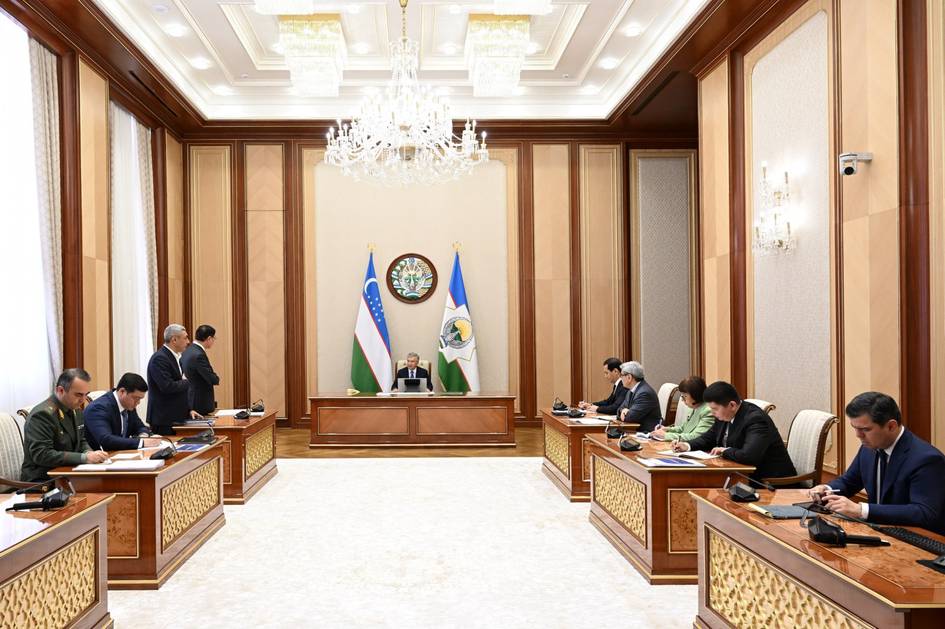
Source: Presidential Press Service
The presentation examined proposals aimed at improving capacity utilization, increasing the share of finished products, and expanding export markets. Plans include the establishment of specialized leather and footwear industrial zones in the Akhangaran district of the Tashkent region and the Shakhrikhan district of the Andijan region. These zones are expected to include production facilities, engineering infrastructure, logistics hubs, design centers, and training institutions, with management assigned to a dedicated directorate under the Light Industry Development Agency.
A new industrial cluster for leather processing is planned in Akhangaran. Currently, around 70% of the country’s 32 leather processing enterprises operate with outdated treatment systems and lack centralized infrastructure. The proposed cluster will include a centralized treatment facility designed to enable the reuse of up to 8,000 cubic meters of treated water per day in production processes.
Measures to expand the raw material base were also discussed. Proposals include organizing centralized imports of cattle hides from neighboring countries through a single-window mechanism, compensating transport costs, and providing working capital to processing enterprises.
Improving the collection and primary processing of small livestock hides was identified as a priority. Plans include establishing collection and processing points in the Navoi, Kashkadarya, Surkhandarya, and Tashkent regions, along with measures to support processing enterprises.
To increase wool processing capacity, a new complex is planned in the Syrdarya region with the capacity to process up to 30,000 tons of wool. The project is intended to create a full production chain from raw materials to finished goods, increasing added value and supporting export growth.
The presentation also addressed plans to expand footwear production, including specialized products, and to develop cooperation with foreign partners. In addition, the expansion of artificial leather production was discussed. Seven projects are planned to establish production lines with a combined capacity of up to 50mn linear meters, aimed at meeting domestic demand and increasing exports.
Officials were instructed to ensure effective implementation of sectoral support measures, improve the financial stability of enterprises, fully utilize production capacities, and support businesses in obtaining international certification.