The World Bank's Board of Executive Directors has approved a $105mn financing package for Uzbekistan to improve learning outcomes in primary schools, supporting a broader $378mn education reform program that aims to strengthen teaching quality, expand school infrastructure, and benefit around 2mn children by 2030.
The financing package includes $100mn in concessional financing from the International Development Association (IDA) and a $5mn grant from the International Finance Facility for Education (IFFEd) to support the implementation of the Transforming Public Education for Economic Growth (BILIM) Program.
According to the World Bank, the initiative marks the first collaboration between the institution and IFFEd.
The overall $378mn program will be financed by the Government of Uzbekistan ($273mn), IDA ($100mn), and IFFEd ($5mn). It will be implemented by the Ministry of Preschool and School Education together with the Ministry of Economy and Finance.
The program will operate across the Republic of Karakalpakstan and the Khorezm, Kashkadarya, Surkhandarya, Bukhara, and Navoiy regions, which together account for around 45% of Uzbekistan's schools and face some of the country's greatest learning and infrastructure challenges.
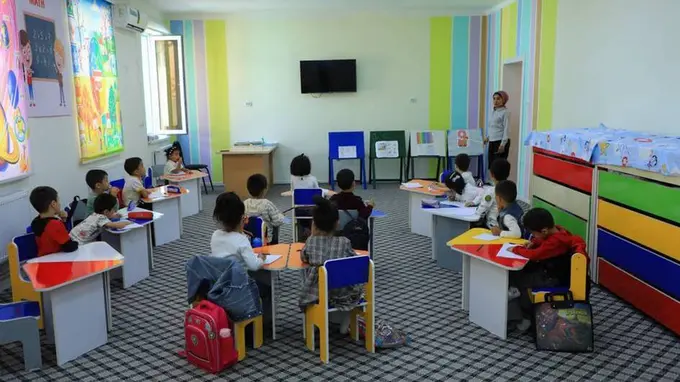
Public schools in Uzbekistan continue to face growing pressure from rapid population growth and internal migration. Student enrollment is projected to exceed 7.6mn in 2026, creating demand for approximately 300 new schools each year.
While primary school enrollment exceeds 99%, the World Bank noted that learning outcomes in reading and mathematics remain below international standards, while teaching methods and professional development require significant improvement.
The focus on strengthening foundational learning follows Uzbekistan's performance in the 2022 Program for International Student Assessment (PISA), where the country scored 364 points in mathematics (OECD average: 472), 336 in reading (OECD average: 476), and 355 in science (OECD average: 485).
More than 7,200 students from over 200 schools participated in the assessment. The World Bank has also been supporting Uzbekistan's preparations for PISA 2025, with the latest BILIM program aiming to strengthen the foundational reading and mathematics skills that underpin later learning outcomes.
By 2030, the BILIM program aims to improve teaching and school management practices for 50,000 teachers, school leaders, and education administrators, create 27,000 new primary school places through school construction and expansion, and strengthen education data systems to improve planning and resource allocation.
The reforms are expected to directly benefit around 2mn pupils in Grades 1–4, approximately half of whom are girls, by improving learning outcomes and strengthening their long-term employment prospects.
The latest financing follows the World Bank's approval in 2025 of a $250mn loan for Uzbekistan's EduImkon program, which aims to expand equitable student financing, modernize the student loan system, improve access for low-income and female students, and better align higher education with labor market needs by 2028.