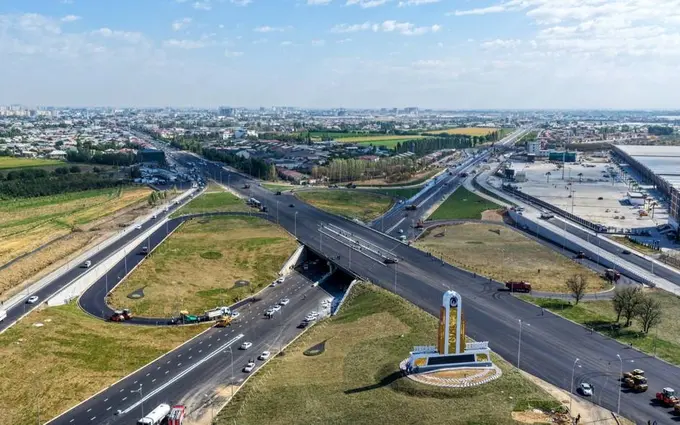
President Shavkat Mirziyoyev inspected a newly completed road interchange at the junction of the A-373 highway and the Tashkent Ring Road during his visit to Tashkent region, as Uzbekistan continues upgrading its transport infrastructure to improve traffic flow and regional connectivity.
The new transport interchange is designed to improve traffic management, enhance road safety, reduce congestion and shorten travel time between Tashkent and Nurafshon by 10–15 minutes.
Built across 14.1 hectares on the border of Bektemir and Oʻrta Chirchiq districts, the project cost UZS 240bn ($18.9mn).
The infrastructure includes a 66-meter-long, 46-meter-wide bridge, a 450-meter underground roadway, two U-turn lanes, four underground pedestrian crossings and a 950-meter circular access road.
Authorities also constructed 9.5 kilometers of pedestrian and cycling paths, eight public transport stops, installed 240 streetlights and six kilometers of road barriers.

Following the project's completion, the route's daily traffic capacity is expected to increase several times over, reaching up to 130,000 vehicles per day, significantly improving transport links between the capital and Tashkent region.
President Mirziyoyev was also presented with plans to introduce a Bus Rapid Transit (BRT) system along the Tashkent–Nurafshon corridor, aimed at providing faster and more efficient public transportation in the growing metropolitan area.
Earlier the same day, President Mirziyoyev launched construction of Uzbekistan's first high-speed toll motorway linking Tashkent and Samarkand. The 282-kilometer, six-lane highway is expected to reduce travel time between the two cities from five hours to around two and a half hours and is scheduled for completion by 2030.