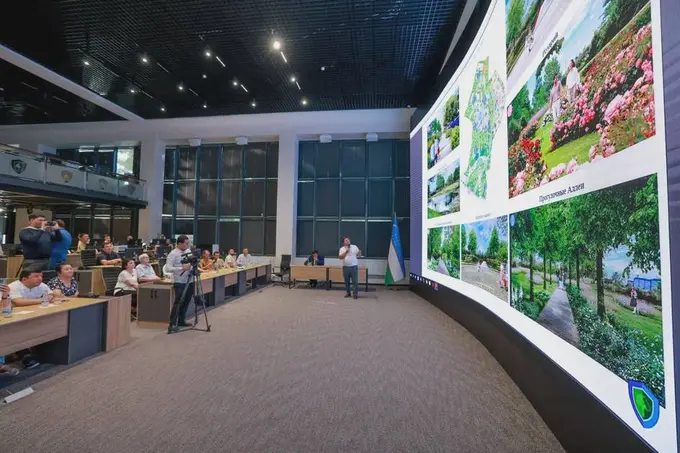
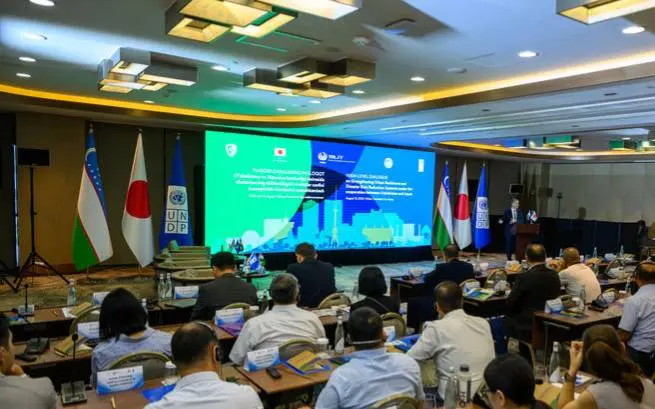
Eco Expo Central Asia 2026 and the Eighth Assembly of the Global Environment Facility (GEF) brought together government officials, international organizations, development institutions, researchers, and civil society representatives in Samarkand to discuss biodiversity conservation, environmental financing, sustainable technologies, and regional cooperation on climate and ecological issues.
The events were held around World Environment Day on June 5 and focused on environmental governance, green investment, ecosystem restoration, and cross-border sustainability initiatives.
Eco Expo Central Asia 2026 attracts international participation
According to organizers, Eco Expo Central Asia 2026 gathered approximately 10,000 participants from more than 100 countries. The event featured around 70 pavilions presenting environmentally focused products and services, 20 startup platforms, and approximately 50 side events dedicated to environmental and sustainability topics.
The expo was opened by Aziz Abdukhakimov, Advisor to the President of Uzbekistan and Chairman of the National Committee on Ecology and Climate Change, together with Inger Andersen, Executive Director of the United Nations Environment Programme (UNEP), and Grethel Aguilar, Director General of the International Union for Conservation of Nature (IUCN).
The event marked the second Eco Expo Central Asia, following the inaugural exhibition held in Tashkent in 2025.
During a plenary session dedicated to green investment and innovation, Abdukhakimov stated that Uzbekistan is moving from the stage of climate commitment formulation toward practical implementation through investment, technology, and innovation.

GEF Assembly convenes in Samarkand
The Eighth Assembly of the Global Environment Facility was held alongside the expo. The assembly serves as the organization's highest governing body and convenes every four years.
Representatives from 186 countries, including ministers, international organizations, and civil society groups, participated in discussions on biodiversity protection, climate policy, environmental financing, and sustainable development.
Green University launches biodiversity finance course
One of the announcements made during Eco Expo 2026 was the launch of a biodiversity finance course at Green University.
According to organizers, the program is the first academic course dedicated specifically to biodiversity finance. It was developed with support from the United Nations Development Programme's Biodiversity Finance Initiative (BIOFIN).
The course is intended to train specialists in environmental finance and biodiversity conservation, with a focus on mechanisms through which governments and businesses can support ecosystem protection and sustainable resource management.
Officials noted that the initiative is linked to efforts to address biodiversity financing needs in Uzbekistan.
New research center announced
During the opening ceremony of the GEF Assembly, President Shavkat Mirziyoyev announced plans to establish the Ulugh Beg Centre for Sustainable Technology and Applied Research.
The center will operate under Green University and focus on research related to renewable energy, water resources, critical minerals, and artificial intelligence.
According to the announcement, the institution will also serve as a national center for the protection of dark skies and the nocturnal environment.
UNDP signs cooperation agreement with Karakalpakstan
The United Nations Development Programme (UNDP) signed a cooperation agreement with the Ecology Committee of the Republic of Karakalpakstan.
According to organizers, this represents the first formal partnership between UNDP and authorities in Karakalpakstan directly, rather than through national-level institutions.
The agreement is intended to support ecosystem restoration, biodiversity conservation, and sustainable water management initiatives in the Aral Sea region.
Officials stated that the partnership complements broader environmental programs focused on integrated management of wetlands, water resources, ecosystems, and local livelihoods.
GEF approves financing for regional environmental projects
The GEF Assembly approved $77.6mn in environmental financing, including support for projects in Central Asia.
One approved initiative focuses on implementation of the Chu-Talas Basin Strategic Action Programme in Kazakhstan and Kyrgyzstan. The project aims to support ecosystem restoration, water resource management, and climate mitigation measures in river basins that serve approximately 3mn people.
The project will be implemented by the United Nations Development Programme with GEF financing of $5.8mn and co-financing of $41.4mn.
Another approved initiative is the Uzbekistan Risk Mitigation Facility, which seeks to support private investment in renewable energy and energy storage projects.
The project will be implemented by the World Bank with GEF financing of $12.8mn and co-financing of $152mn. According to project documentation, the initiative is intended to help mobilize private investment in renewable energy infrastructure.
Environmental agreements signed
Several agreements and partnership initiatives were announced during the expo.
Among them was an agreement aimed at strengthening Uzbekistan's national biosafety framework in accordance with international standards. The initiative is supported by the GEF in cooperation with the IUCN, the Food and Agriculture Organization of the United Nations (FAO), and the Secretariat of the Convention on Biological Diversity.
Another agreement focused on integrated water management and water security in the Lower Amu Darya Basin. The document was signed by Uzbekistan's National Committee on Ecology and Climate Change, the Ministry of Water Resources, and the Ministry of Agriculture.
Participants also launched the operational phase of the Regional Environmental Performance Review for Central Asia, a regional initiative intended to strengthen cooperation on environmental management, climate resilience, and natural resource governance.
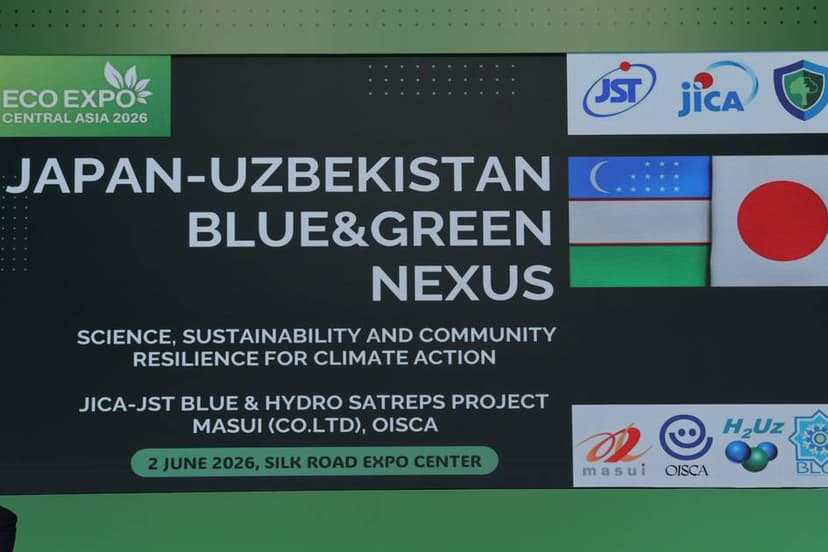
In addition, representatives of Japan and Uzbekistan held a joint "Blue & Green Nexus" session focused on scientific and environmental cooperation in the Aral Sea region.