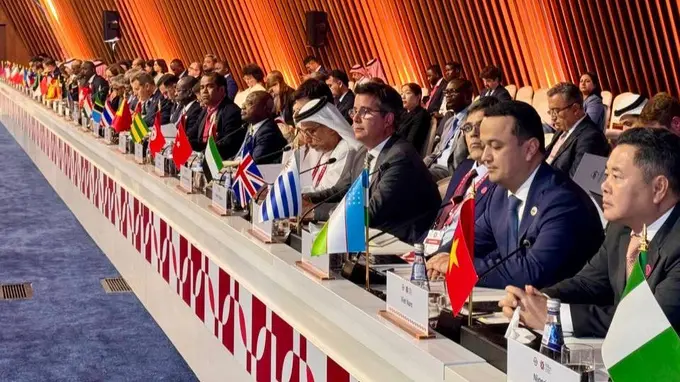
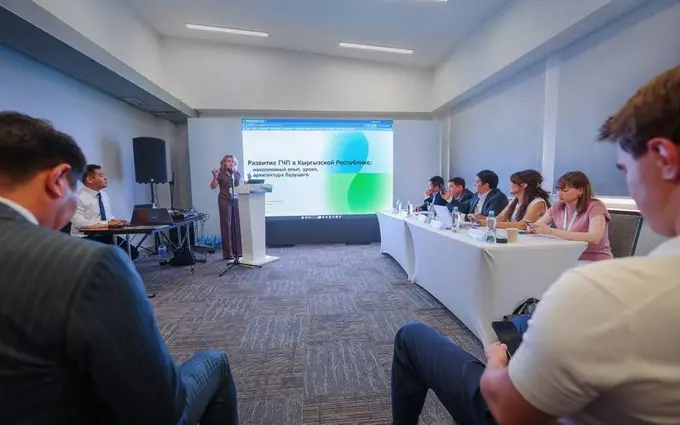
A panel session titled “The Water-Energy-Food Nexus: Climate Resilience and Agricultural Investment” was held within the framework of the Tashkent International Investment Forum (TIIF). The discussion focused on water and food security challenges in Uzbekistan and the broader Central Asian region, as well as investment needs and technological approaches for improving resource efficiency.
The session brought together government representatives, international organizations, and industry experts to examine the interconnection between water use, energy systems, and agricultural production, with particular attention to long-term resource management and climate-related risks.
Water demand projections and sectoral pressures
Igor Alekseev, managing director and partner at Boston Consulting Group (BCG), who moderated the session, presented projections on future water demand. According to his remarks, total water demand is expected to increase by 23% over the next 10–20 years, driven by population growth and economic expansion.
Alekseev also outlined sector-specific estimates, stating that by 2040 water demand may increase by 150% in industry, 60% in utilities, and 15% in agriculture. Alekseev noted that climate change and reduced transboundary water flows could contribute to potential regional water shortages by 2040, emphasizing the importance of improving water-use efficiency across sectors.
Agriculture’s role in Uzbekistan’s economy
Nuriddin Kushnazarov, adviser to the Minister of Agriculture of Uzbekistan, provided data on the agricultural sector’s contribution to the national economy. He stated that agriculture accounts for 19% of GDP and employs 27% of the working-age population.
According to Kushnazarov, agricultural production reached $40bn in the previous year, with a government target to increase this figure to $60bn in the coming years.

Kushnazarov also noted that approximately 90% of Uzbekistan’s water resources are used in agriculture, while around 80% of water supply originates from transboundary sources. He reported that water-saving technologies have been introduced on nearly 2.5mn hectares out of 4.3 mn hectares of irrigated land, with plans to extend their use across all irrigated areas by 2030. Subsidy mechanisms for water-saving technologies have been consolidated under a single system administered by the Agency for Payments in the Agrarian Sector.
Environmental risks and regional cooperation
Ahmad Raza, Senior Policy Officer at the Food and Agriculture Organization (FAO) Office for Central Asia, highlighted environmental changes in the region, noting that approximately 30% of glaciers have disappeared over the past 50 years.
Raza emphasized the need for coordinated policy approaches, digital tools, and cross-border cooperation. Raza also suggested broader use of satellite data in resource monitoring and proposed that subsidies be directed toward environmentally sustainable projects focused on natural resource protection.
Investment requirements and technology adoption
Dr. Shihab Elborai, lead partner at Strategy, discussed the relationship between economic growth and resource consumption. He stated that Central Asia is already experiencing water-related constraints and highlighted the importance of decoupling economic development from resource use.
Dr. Shihab Elborai estimated that modernization of water and agricultural infrastructure in the region requires approximately $40bn in investment. Elborai also referenced emerging agricultural technologies, including precision fermentation, noting differences in water usage between traditional protein production methods and alternative technologies.
Balazs Hendrich, Chairman of the Board of the Drought Prevention Institute of the Organization of Turkic States, emphasized the importance of regional cooperation and joint implementation of research and investment projects. Hendrich noted the role of coordinated efforts within multilateral frameworks in addressing water and food security challenges.
Participants of the session discussed water scarcity and food security as structural challenges affecting economic development in Central Asia. The discussion highlighted the role of efficiency improvements in water use, expansion of climate-resilient agricultural technologies, and increased investment in infrastructure.