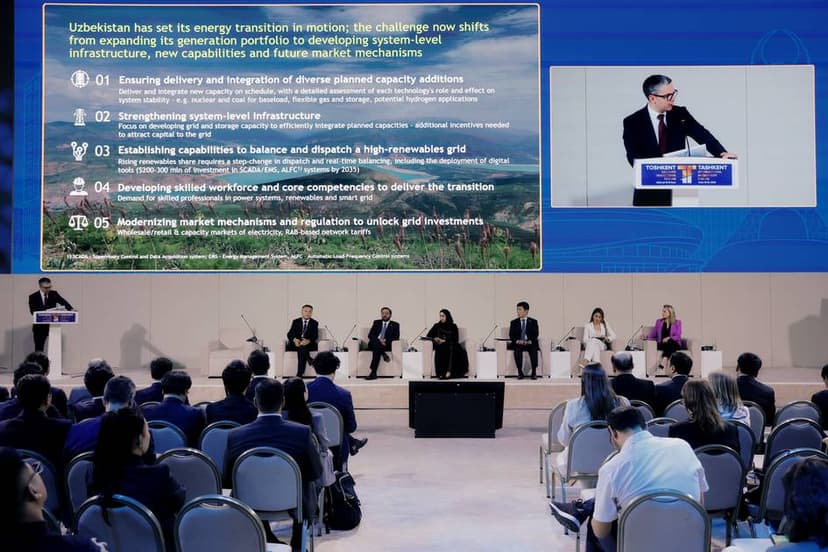
At the Tashkent International Investment Forum (TIIF-2026), a panel session titled “Energy Transition: Renewables, Nuclear and Hydrogen in Central Asia” brought together government officials, international financial institutions, energy companies, and industry experts to discuss the region’s energy transition, investment requirements, and infrastructure priorities.
The discussion focused on energy security, renewable energy development, grid modernization, and financing mechanisms needed to support Central Asia’s long-term transition toward a more diversified energy mix.
Regional energy transition targets
Participants noted that Uzbekistan and other Central Asian countries have set a target of increasing the share of renewable energy sources in the regional energy balance to 40% by 2030. Achieving this objective will require significant investment in generation capacity, transmission infrastructure, energy storage systems, and digital technologies.
The session examined key financial instruments used to support energy projects, including long-term Power Purchase Agreements (PPAs), which are widely used to attract private and foreign investment into renewable energy projects. Discussions also covered bankability requirements for large-scale infrastructure projects and the role of international financial institutions in financing the energy transition.
Government, industry, and financial sector participation
The session was moderated by Igor Alekseev, Managing Director and Partner at Boston Consulting Group (BCG).
Participants included:
- Jurabek Mirzamahmudov, Minister of Energy of Uzbekistan;
Abid Malik, president for Acwa Central Asia;
- Maryam Almazrouie Rashed, Head of Business Development for the CIS region at Masdar;
- Sule Kilic, Director for Turkiye, Caucasus, Central Asia, and Mongolia and Head of Eurasia Energy at the European Bank for Reconstruction and Development (EBRD);
- Wang Hongzhi, Head of China’s State Energy Administration;
- Sama Bilbao y Leon, Director General of the World Nuclear Association (WNA);
- Takefumi Nishikawa, Executive Officer and COO of the Energy Solutions and Public Infrastructure Department at Sojitz Corporation.
The participation of energy developers, international lenders, and nuclear industry representatives reflected the broad range of technologies and financing models being considered as part of the region’s energy strategy.
Grid modernization identified as key challenge
During the discussion, Uzbekistan’s Deputy Minister of Energy Umid Mamadaminov stated that the country has attracted billions of dollars in foreign direct investment into the energy sector in recent years and has commissioned substantial renewable energy capacity.
According to the deputy minister, one of the most significant challenges over the next six to ten years will be the development of flexible and reliable electricity networks capable of integrating growing volumes of solar and wind generation into the national power system.
As renewable energy output varies depending on weather conditions, maintaining grid stability will require significant upgrades to existing infrastructure and the deployment of balancing technologies.

Four priority areas for the next decade
The Ministry of Energy outlined four strategic priorities for the coming eight to ten years.
The first priority is the construction of new high-voltage transmission lines and modernization of electricity distribution networks to ensure reliable delivery of power from generation sites to consumers.
The second priority involves the development of reserve and balancing capacity through battery energy storage systems (BESS), combined-cycle gas turbine (CCGT) plants, and pumped-storage hydropower stations (PSH). These technologies are expected to help stabilize the grid and manage fluctuations in renewable energy generation.
The third priority focuses on digitalization of the power sector. This includes advanced management systems for solar and wind power plants, implementation of forecasting technologies, and the use of artificial intelligence and big data tools to improve operational efficiency and planning.
The fourth priority is regional integration and cooperation with neighboring countries. Uzbekistan is currently participating in regional initiatives supported by the World Bank and the Asian Development Bank, including the REMIT project and balancing market development programs.
Regional cooperation and electricity exports
Officials also highlighted work on the proposed “Green Corridor” initiative, which aims to facilitate electricity exports from Central Asia to European markets through international transmission infrastructure, including subsea cable connections.
The project forms part of broader efforts to strengthen regional electricity trade and improve connectivity between Central Asian energy systems and external markets.
According to the Ministry of Energy, future development of the sector will require a balanced approach that combines investment in new generation capacity with modernization of power networks and storage infrastructure.
Participants concluded that grid resilience, digital technologies, energy storage solutions, and regional cooperation will play a central role in supporting Central Asia’s energy transition and achieving renewable energy targets over the coming decade.