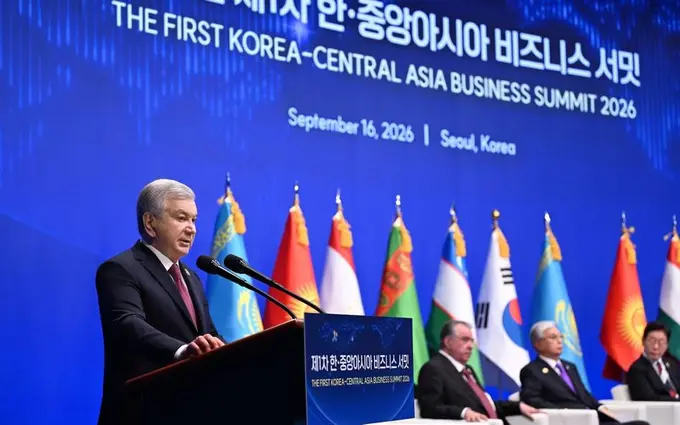
President of Uzbekistan Shavkat Mirziyoyev reviewed proposals aimed at reducing the state’s role in the economy and accelerating privatization processes, as it was reported by presidential press service on April 6.
Data presented during the briefing indicated that the state’s share in the economy currently stands at 42%, with 1,685 state-owned enterprises in operation. In 2025, state assets worth nearly UZS 30 trillion (over $2.4bn) were privatized, generating more than UZS 10 trillion (over $821mn) in budget revenues. Sales of land plots also increased, reaching UZS 6 trillion (around $493mn).
A system of financial incentives has been introduced to support privatization. Under this mechanism, UZS 2.6 trillion (over $213mn) remain at the regional level and UZS 7bn (around $575,000) within local communities. State-owned enterprises contributed UZS 49 trillion (over $4.02bn) to the state budget in dividends. Over the past five years, the number of state-owned enterprises has decreased by 60% as a result of privatization measures.
Despite these developments, the review identified a number of unresolved issues. Authorities emphasized the need to strengthen requirements for new owners, particularly regarding job preservation, the introduction of modern technologies, and improvements in production efficiency. The number of inefficient state-owned enterprises reached 362 in 2025.

The analysis also highlighted limitations in the use of digital tools and artificial intelligence in evaluating state-owned enterprises. In 2024, 451 enterprises in difficult financial conditions reported combined losses of UZS 14 trillion (over $1.1bn), while in 2025, 362 enterprises recorded losses totaling UZS 4 trillion (over $328mn). It was noted that more comprehensive financial analysis and early risk identification mechanisms are required.
A sector-based approach to privatization has been proposed, involving detailed assessments of each industry, including socio-economic impacts and the competitive environment, to inform decision-making.
The meeting also addressed the use of state property in the regions. Plans include introducing a unified management system and reducing the average space allocated per employee from 27 square meters to 12–15 square meters. This is expected to make 4.9mn square meters of space available for economic use, allowing vacant facilities to be leased or sold and reducing maintenance costs.
Land use was identified as another area requiring attention. Of the 11,400 hectares of land allocated to entrepreneurs between 2022 and 2025, economic activity has not been established on 3,100 hectares. Authorities proposed introducing online monitoring systems and strengthening criteria for participation in investment projects. Integration of digital platforms, including “E-auksion,” “Yerelektron,” the Uzbekcosmos system, “Shaffof qurilish,” and “UzKAD,” is expected to improve oversight and facilitate the identification of unused land.
It was also decided that land plots for business purposes will be auctioned as ready-made projects, including all necessary permits. Local authorities are expected to play a greater role in bringing unused land into economic circulation.
The briefing included updates on preparations for the privatization of major assets, including UzAuto Motors, Navoiyazot, and thermal power plants.
In addition, a proposal was made to establish a digital project office within the State Assets Management Agency. The office would oversee online monitoring of privatization processes, introduce artificial intelligence into financial analysis, and improve revenue distribution mechanisms.
The president instructed relevant authorities to continue reducing the state’s presence in the economy, ensure efficient use of assets, and accelerate privatization using modern analytical and digital approaches.