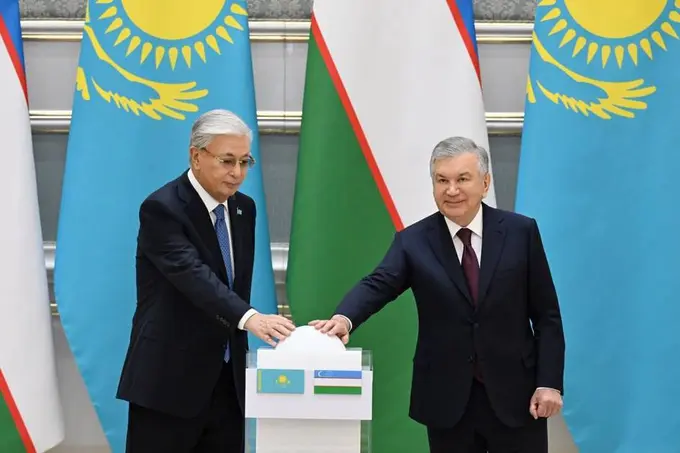
Kazakh Majilis Speaker Yerlan Koshanov addressed the third session of the Council for Inter-Parliamentary Cooperation between the Majilis of Kazakhstan and the Legislative Chamber of the Oliy Majlis of Uzbekistan in Bukhara on April 3, highlighting ongoing collaboration and bilateral initiatives across political, economic, and social sectors, as to the Kazakh Majilis press service.
Koshanov emphasized that strong political dialogue between Kazakhstan and Uzbekistan, led by Presidents Kassym-Jomart Tokayev and Shavkat Mirziyoyev, forms the foundation for effective cooperation across all branches of government in both countries. He noted that the Council’s activities align with agreements reached by the heads of state and serve as a platform for advancing legislative support for joint initiatives, particularly in culture, education, and tourism.
During the session, Koshanov provided an overview of Kazakhstan’s constitutional reforms, reporting that the recent referendum was supported by 87% of voters. He highlighted that the new Constitution, referred to as the “People’s Constitution,” aims to strengthen governance by balancing presidential authority, parliamentary influence, and government accountability. Uzbek deputies expressed interest in parliamentary reforms and new institutions, including the Vice-Presidency and the Khalyq Kenesi (People’s Council).
Koshanov also reviewed the results of inter-parliamentary cooperation, citing the ratification of key agreements, including the Treaty on Allied Relations, mutual travel conditions for citizens, environmental protection cooperation, and regulations for the Central Asia International Center for Industrial Cooperation. He highlighted consistent collaboration between Kazakhstan and Uzbekistan at international parliamentary platforms, including the Inter-Parliamentary Union, OSCE Parliamentary Assembly, CIS Inter-Parliamentary Assembly, and TurkPA, as well as the Central Asian Women’s Dialogue.

Uzbek Legislative Chamber Speaker Nuriddin Ismoilov noted that 2025 had been productive for bilateral parliamentary engagement, citing the November 2025 visit of President Tokayev to Uzbekistan, which resulted in agreements to enhance cooperation and the launch of major joint projects. Ismoilov congratulated Kazakhstan on the successful constitutional referendum and affirmed continued collaboration through the Council for Inter-Parliamentary Cooperation.
The session included discussions on economic relations. Kazakhstan is among Uzbekistan’s top three trading partners, with mutual trade reaching $4.8bn in 2025, a 16% increase from the previous year. Both countries have set an ambitious goal to increase bilateral trade to $10bn. Koshanov noted that 78 joint projects worth $1.8bn have been completed, including the Kazakhstan Trade Pavilion at the Termez International Trade Center, and emphasized the importance of legislative support for ongoing industrial, infrastructure, and logistics initiatives.
Environmental and technological cooperation was also addressed. Koshanov discussed the implementation of the Taza Qazaqstan Environmental Culture Development Concept for 2024–2029 and invited Uzbek colleagues to participate in the upcoming Central Asian Regional Environmental Summit in Astana. In the field of technology, he noted that Astana Hub and IT Park Uzbekistan are cooperating under the Central Asian Innovation Hubs brand, forming a unified regional technological hub.
Tourism development was highlighted as a priority. Koshanov and Uzbek delegates reviewed progress on the 2026–2027 Joint Action Plan for Tourism Cooperation, aimed at modernizing tourism infrastructure, attracting international visitors, and expanding cross-border transport routes. By the end of 2025, Kazakhstan and Uzbekistan accounted for over half of Central Asia’s total tourist arrivals, with growing demand for railway and bus connections.
The council also examined practical cooperation in trade, economic and agricultural sectors, sustainable development, the green economy, energy, and digitalization. Education and cultural exchange initiatives were discussed as key components of long-term bilateral engagement.
The next session of the Council for Inter-Parliamentary Cooperation is scheduled to take place in Turkistan, Kazakhstan.