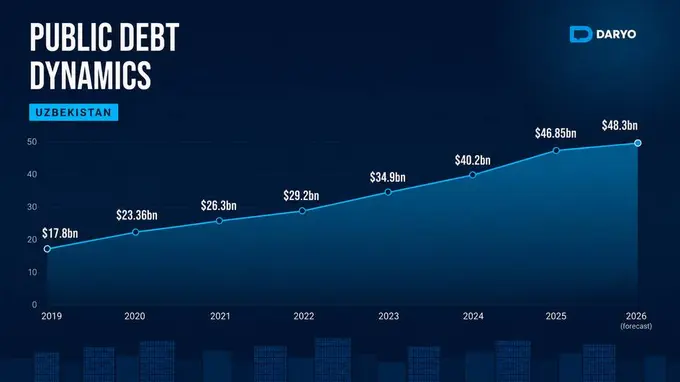
Since the start of the year, debt has risen by $3.16bn, while compared to the same period in 2024, the figure is up by $6.13bn. The majority of Uzbekistan’s debt stems from external sources, which account for $36.41bn, or 84% of the total. Domestic debt stands at $6.96bn. The ratio of external debt to GDP climbed to 28.7%, increasing by $5.5bn year-on-year.
The World Bank remains Uzbekistan’s largest creditor, with $7.8bn allocated. It is followed by the Asian Development Bank with $7.4bn and international investors with $5.7bn.
Other creditors include Chinese financial institutions with $3.8bn, Japanese financial institutions with $3.2bn, and the Asian Infrastructure Investment Bank (AIIB) with $1.7bn. French financial institutions account for $1.1bn, while the Islamic Development Bank’s share stands at $935mn.
Korean financial institutions have provided $750mn, the International Monetary Fund $642mn, and Germany’s state bank $481mn. The European Bank for Reconstruction and Development has extended $401mn, while other financial institutions collectively account for $2.5bn.
Borrowed funds are being directed into several priority areas of the economy. Budget support accounts for the largest share, totaling $17bn, or 47% of the debt. The fuel and energy sector has received $5.89bn, making up 16%, while agriculture and water management projects account for $3.13bn, or 9%.
Housing and communal services stand at $3bn, and transport and infrastructure at $2.91bn, each representing about 8% of the allocation. Healthcare, education, and information and communication technologies received $2.93bn, also making up 8%. Smaller portions of the debt have been allocated to entrepreneurship and industrial support at $851mn, or 2%, and the chemical industry at $729mn, also 2%.
Follow Daryo's official Instagram, LinkedIn, and Twitter pages to keep current on world news