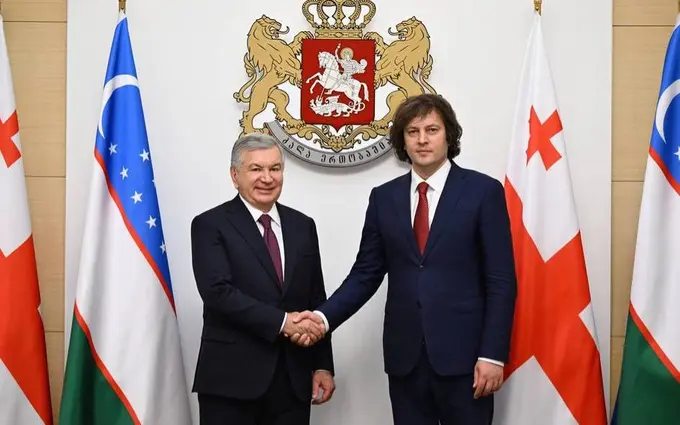
President Shavkat Mirziyoyev and Georgian Prime Minister Irakli Kobakhidze agreed on a roadmap to increase bilateral trade to $1bn, strengthen transport connectivity, and expand investment cooperation during the first official visit by an Uzbek president to Georgia in more than 20 years.
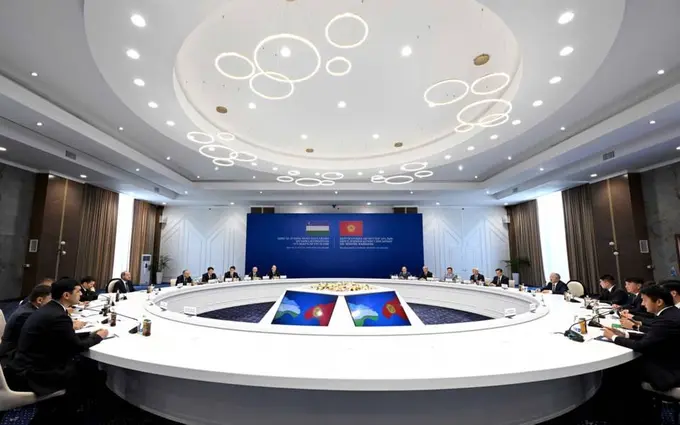
Meeting in both narrow and expanded formats with official delegations, the two leaders discussed expanding cooperation in trade, investment, transport and transit, tourism, digitalization, and cultural and humanitarian exchanges.
Mirziyoyev described the visit as a milestone that would elevate Uzbekistan-Georgia relations to a qualitatively new level, noting that it is the first official visit by an Uzbek president to Georgia in over two decades.
The leaders welcomed the growing dialogue between their governments, parliaments, business communities, and cultural institutions, emphasizing the importance of maintaining high-level contacts.
Bilateral trade reached $270mn in 2025 and exceeded $100mn during the first months of 2026. The sides agreed to adopt a joint roadmap aimed at increasing annual trade to $1bn, reducing trade imbalances, and expanding supplies of high-demand products through reciprocal industrial exhibitions.

Transport and investment
Transport and logistics featured prominently in the talks, with both sides discussing measures to strengthen transit cooperation and better utilize existing transport infrastructure.
The leaders supported expanding the use of Georgia's Poti and Batumi ports for Uzbek cargo and backed plans to establish a logistics hub in Georgia, including an industrial zone and a permanent showroom for Uzbek products.
Mirziyoyev also welcomed the launch of the Baku-Tbilisi-Kars railway and proposed studying its integration with the future China-Kyrgyzstan-Uzbekistan railway, which is expected to enhance regional connectivity and trade along the Middle Corridor.
Industrial cooperation was identified as another priority area. The leaders welcomed the outcome of the joint business forum held a day earlier, during which the two countries signed a Cooperation Program extending through 2027.
The program includes projects in agriculture, electrical engineering, energy, pharmaceuticals, food processing, light industry, construction materials, digitalization, information technology, digital banking, and tourism.
To support new initiatives, the Uzbek side proposed establishing a joint investment fund.

Cultural and diplomatic ties
The two sides also highlighted growing cultural and humanitarian cooperation. Earlier this year, Tashkent hosted Georgian Culture Days, while Mirziyoyev thanked the Georgian government for its decision to name one of Tbilisi's parks after the renowned Uzbek poet Alisher Navoi.
The countries also plan to organize joint education and tourism forums later this year.
In a further step toward strengthening bilateral relations, Uzbekistan decided to establish its embassy in Georgia.
The leaders agreed that a joint implementation roadmap would be prepared to ensure the timely execution of the agreements reached during the visit.
Economic ties between Uzbekistan and Georgia have strengthened in recent years. Bilateral trade tripled between 2017 and 2025 to reach nearly $270mn, while Georgia has become an increasingly important gateway for Uzbek exports through the Trans-Caspian International Transport Route, or Middle Corridor.

Agreements signed
Following the talks, President Shavkat Mirziyoyev and Georgian Prime Minister Irakli Kobakhidze signed a Declaration on Establishing Strategic Partnership, elevating bilateral relations to a new level.
In the presence of the two leaders, the sides also exchanged a broad package of bilateral agreements and memorandums covering customs cooperation and mutual administrative assistance, information and communication technologies and digitalization, vocational and higher education, science and innovation, as well as a 2026–2027 intergovernmental cooperation program.
The package further included a 2027–2030 cultural cooperation program, a memorandum of understanding between the finance ministries, an agreement on introducing the E-Permit electronic permit exchange system, and memorandums on cooperation in agriculture, environmental protection, healthcare, radiation protection and nuclear safety, labor migration, and tourism.
Additionally, the Compulsory Enforcement Bureau under Uzbekistan's Prosecutor General's Office and Georgia's National Bureau of Enforcement signed a separate memorandum on institutional cooperation.