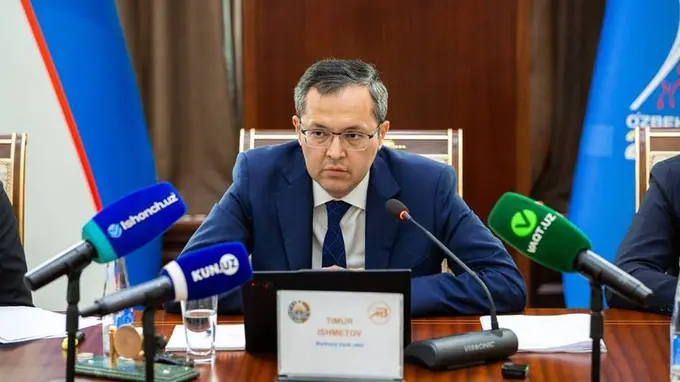
Uzbekistan’s state borrowing directly and indirectly influences the formation of the national currency’s exchange rate, Central Bank Deputy Chairman Nodirbek Achilov said during a meeting with exporters in Tashkent on February 26.
Speaking at a dialogue with business representatives, Achilov explained that dozens of factors shape the exchange rate, with fiscal policy playing a significant role in the strengthening or depreciation of the soum.
“Government expenditures account for nearly 40% of GDP. At the same time, there are revenues, public debt and the costs of attracting external borrowing. All of this indirectly affects the exchange rate,” he said.
According to the official, Uzbekistan attracts around $5bn in public debt annually. This year, $2.5bn is planned to cover the state budget deficit and another $2.5bn to finance investment projects. The borrowed $5bn enters the market directly and later influences the exchange rate through Central Bank operations and financial interactions with the government.
Achilov also noted that state investment programs within fiscal policy frameworks contribute to currency dynamics.

External and market factors
The deputy chairman emphasized that external factors significantly impact the exchange rate. These include currency movements, inflation levels and interest rates in Uzbekistan’s main trading partner countries, as well as the volume of remittances.
Global commodity prices — including gold, silver, copper and oil — alongside export and import performance, are also key determinants of currency fluctuations.
He added that geopolitical developments, international capital flows, global interest rates and the level of dollarization in the domestic economy influence exchange rate formation.

Monetary policy tools used by the Central Bank — such as credit conditions, deposit volumes, interest rates, liquidity management and inflation targeting — also play a role. Financial operations conducted by the government, the Central Bank and the Fund for Reconstruction and Development were cited as additional influencing factors.
At the end of 2025, Uzbekistan’s total public debt exceeded $46.85bn. Of this amount, $39.8bn (85%) represented external debt, while $7bn (15%) was domestic debt. External debt increased by $6.1 bn over the year. The overall public debt-to-GDP ratio stood at 31.9%.
For 2026, UZS 24 trillion ($2bn) has been allocated in the state budget to service public debt interest payments.